
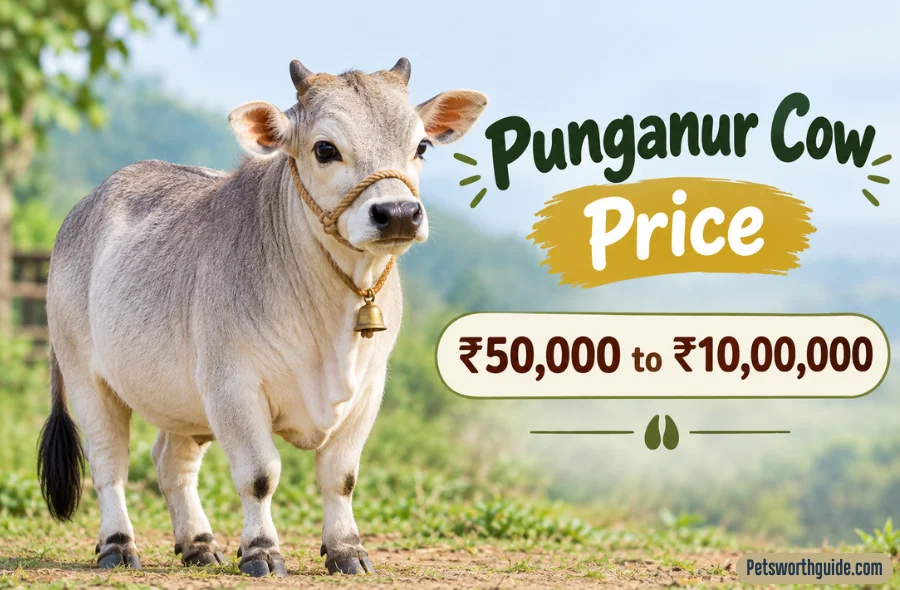
The Punganur cow price in India typically ranges from ₹50,000 to ₹10,00,000 in 2026, depending on the animal’s age, breed purity, health status, and milk yield history.
Disclaimer: Prices listed in this article are indicative and vary based on individual animal health, purity, age, location, and seller reputation. Always consult a certified veterinarian before purchasing livestock. This article is for informational purposes only.
Punganur Cow at a Glance
| Feature | Details |
|---|---|
| Breed Name | Punganur Cattle |
| Origin | Punganur, Chittoor District, Andhra Pradesh, India |
| Height (Cows) | 70–90 cm at shoulder (Wikipedia: avg. 97 cm for cows) |
| Height (Bulls) | Up to 107 cm |
| Weight (Cows) | 115–200 kg |
| Weight (Bulls) | 200–250 kg |
| Coat Colour | White, light grey, brown, red, or rarely black |
| Horn Type | Short, crescent-shaped |
| Milk Yield Per Day | 3–5 litres |
| Milk Fat Content | 8% (industry avg: 3.5%) |
| Lifespan | 12–15 years |
| Temperament | Gentle, docile, calm |
| Feed Intake Per Day | ~5 kg |
| Conservation Status | “Not at risk” (DAD-IS, 2024); population: ~9,876–13,275 (2022) |
What Is the Punganur Cow?
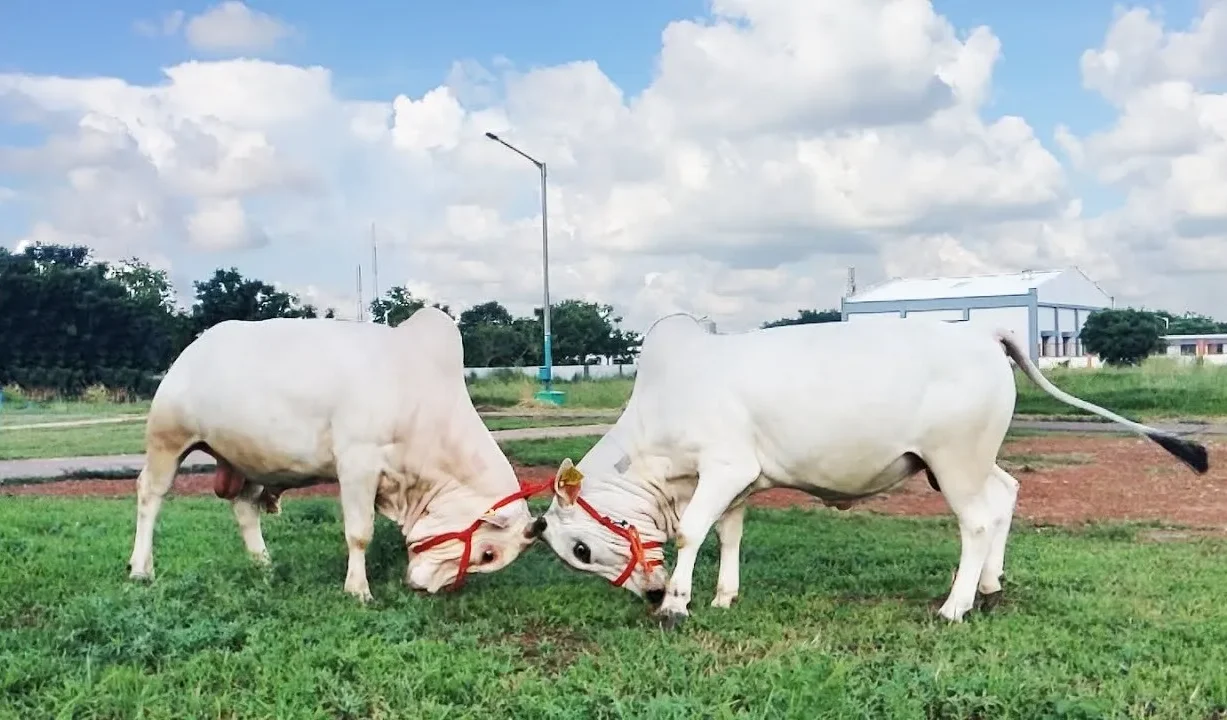
A cow small enough to fit in a compact urban backyard but mighty enough to produce milk richer than most full-sized desi breeds. That is the Punganur cow in a nutshell.
This tiny wonder hails from the Punganur town in Chittoor district of Andhra Pradesh. It is officially one of the smallest zebuine (humped) cattle breeds on the planet. If you remember the viral photos from January 2024 of Prime Minister Narendra Modi feeding a teeny cow on Makar Sankranti, that was a Punganur. The breed went from being a well-kept regional secret to a national sensation almost overnight.
The Punganur cow is not just adorable. It is drought-resistant, thrives on dry fodder, consumes less feed than larger breeds, needs less space, and produces A2 milk with an 8% fat content — nearly double what most standard Indian breeds offer. The Tirupati Thirumala Temple in Andhra Pradesh uses Punganur cow milk for its sacred Ksheeraabhishekam rituals. That tells you everything about its status.
Punganur Cow Price in India 2026: The Complete Breakdown
Here is where things get interesting. The Punganur cow price is not fixed. There is no government rate card. Every sale is negotiated individually.
Important Note on Price Discrepancy: You will find wildly different numbers online. Some sources quote ₹40,000 (a verified listing on Pashushala.com from July 2026 for a 2.5-year-old cow in UP with 2 litres/day yield). Others quote up to ₹10,00,000 for pedigree-certified, high-yield animals. Both figures are accurate — they just describe very different animals. A low-yield, crossbred animal in a rural UP market is nowhere near the same product as a DNA-verified, high-fat-yield Punganur from a reputed breeder in Andhra Pradesh. The more reliable working range for a healthy, genuine Punganur cow price is ₹1,00,000 to ₹3,00,000 for a standard adult cow, with premium and pedigree cows going much higher.
| Category | Price Range (INR) |
|---|---|
| Baby / Calf (up to 6 months) | ₹25,000 – ₹80,000 |
| Young Cow (6–18 months, non-milking) | ₹50,000 – ₹1,50,000 |
| Adult Milking Cow (standard quality) | ₹1,00,000 – ₹3,00,000 |
| High-Yield Milking Cow (certified) | ₹3,00,000 – ₹6,00,000 |
| Pedigree / Show-Quality / Rare Lineage | ₹6,00,000 – ₹10,00,000 |
Baby Punganur Cow Price and Miniature Punganur Cow Price
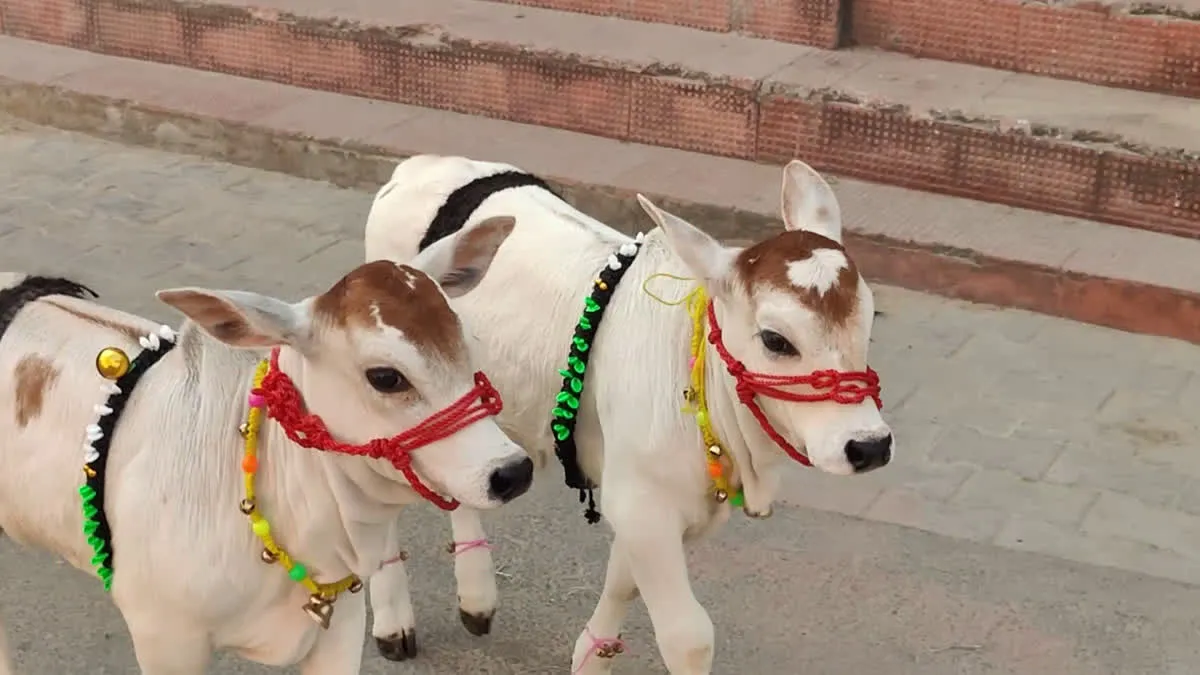
The baby Punganur cow price ranges from ₹25,000 to ₹80,000 depending on the calf’s health, gender, and the breeder’s reputation. Female calves cost more because they have future milking potential.
The miniature Punganur cow price in India is often used interchangeably with the breed itself, since the Punganur IS a miniature cow. However, sellers often use this term to market particularly compact or exceptionally small animals, which can push prices above ₹2,00,000 even for young animals. Be cautious — “miniature” is a marketing descriptor here, not an official sub-breed classification.
Punganur Cow Price Online
Buying a Punganur cow price online is now very much a reality. Platforms like Pashushala.com list active Punganur cattle for sale with photos, milk yields, age, and lactation details. A July 2026 listing on Pashushala showed a 2.5-year-old, first-lactation Punganur cow with a 2 litre/day yield priced at ₹40,000 in Uttar Pradesh.
However, online prices can be misleading. Low-priced listings often indicate crossbred animals or cows with compromised health or unverified lineage. Always insist on:
- Vaccination records
- Veterinary health certificate
- Lactation history (if adult)
- Ideally, video of the cow and on-site verification
Punganur Cow Price Across Major Indian States (2026)
The Punganur cow price varies significantly by state due to demand, transportation costs, and local availability. The breed is native to Andhra Pradesh, so prices tend to be lower there. States farther from the origin — particularly North and Central India — typically charge more due to transport and relative scarcity.
| State | City | Estimated Price Range (INR) |
|---|---|---|
| Andhra Pradesh (Origin State) | Chittoor, Tirupati | ₹50,000 – ₹2,50,000 |
| Punganur Cow Price in UP | Lucknow, Faizabad, Kanpur | ₹40,000 – ₹2,00,000 |
| Punganur Cow Price in Lucknow | Lucknow | ₹70,000 – ₹2,50,000 |
| Punganur Cow Price in Maharashtra | Pune, Mumbai, Nagpur | ₹80,000 – ₹3,00,000 |
| Punganur Cow Price in Pune | Pune | ₹90,000 – ₹3,50,000 |
| Punganur Cow Price in MP | Bhopal, Gwalior | ₹70,000 – ₹2,50,000 |
| Punganur Cow Price in Indore | Indore | ₹80,000 – ₹2,80,000 |
| Punganur Cow Price in Odisha | Bhubaneswar, Cuttack | ₹65,000 – ₹2,20,000 |
| Punganur Cow Price in Patna | Patna | ₹70,000 – ₹2,50,000 |
Note: These are indicative ranges based on marketplace data and regional demand patterns as of September 2026. Actual prices depend on individual animal quality. Always verify with a local vet or breeder before purchasing.
Punganur Cow Milk Price Per Litre and Daily Yield
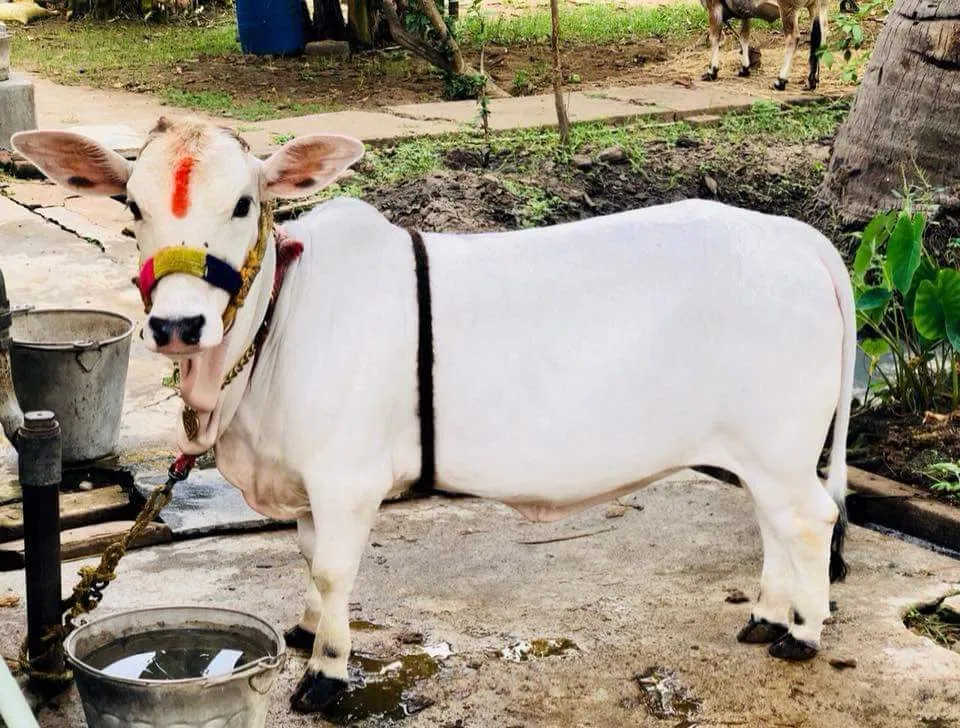
How Much Milk Does a Punganur Cow Give Per Day?
The Punganur cow milk per day yield sits at 3 to 5 litres on average. Some listings report as low as 2 litres/day for younger or lower-quality cows — which is consistent with the ₹40,000 Pashushala listing. High-quality, well-fed cows at peak lactation can push closer to 5 litres.
What the yield lacks in volume, it more than makes up for in quality:
- Fat content: 8% (industry average is 3.5%)
- Naturally A2 milk (easier to digest)
- Rich in Omega fatty acids, calcium, potassium, and magnesium
- Widely used in Ayurvedic formulations and temple rituals
Punganur Cow Milk Price Per Litre
The Punganur cow milk price per litre is not standardized. It is typically sold locally or consumed within the household. Where it IS sold commercially, prices range from ₹80 to ₹150 per litre in 2026, significantly higher than regular cow milk (₹40–60/litre) due to scarcity and A2 premium. One older source (Goel Vet Pharma) cited ₹50–80/litre, but current A2 milk premiums have pushed that upward — the ₹80–150 range better reflects 2026 market realities.
| Milk Type | Price Per Litre (2026) |
|---|---|
| Regular cow milk (market rate) | ₹40 – ₹60 |
| Standard A2 desi cow milk | ₹70 – ₹100 |
| Punganur cow milk | ₹80 – ₹150 |
| Premium Punganur ghee (per kg) | ₹2,500 – ₹5,000 |
Punganur Cow Height and Size: Just How Small Is Small?
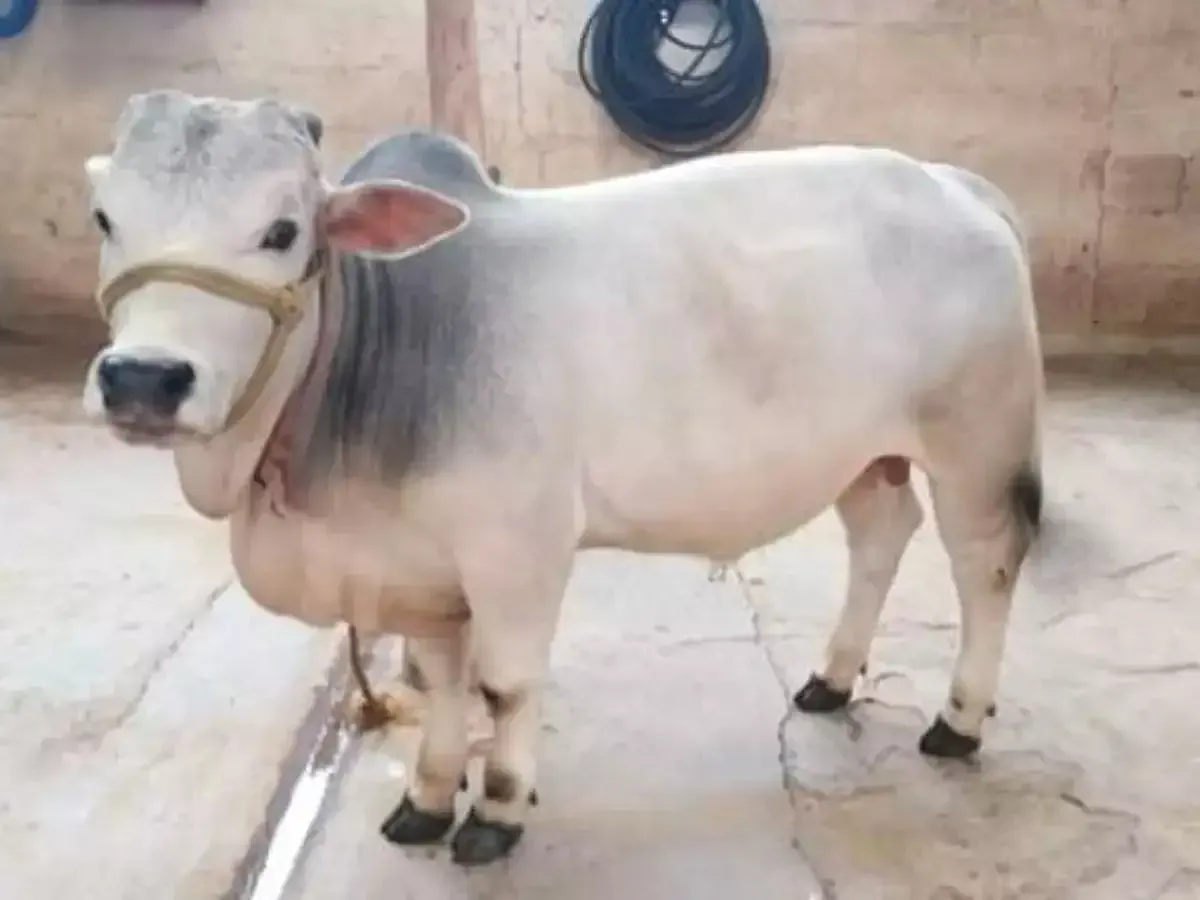
The Punganur cow height ranges between 70 and 90 cm at the shoulder for cows, and up to 107 cm for bulls. This makes them roughly the height of a large dog.
Note on measurement discrepancy: Some sources (Pashushala, Goel Vet Pharma, KamdhenGauveda) report 70–90 cm as the height range for cows, while Wikipedia’s entry for Punganur cattle (citing DAD-IS data) states the average cow height is 97 cm, with bulls at 107 cm. The DAD-IS figure is the more systematically collected scientific measurement, while field sources report what is commonly observed. Both ranges are worth noting — the typical animal you encounter will fall in the 70–90 cm range, with some better-nourished individuals reaching 97 cm.
Punganur Cow Size Comparison
| Breed | Shoulder Height | Average Weight |
|---|---|---|
| Punganur Cow | 70–97 cm | 115–200 kg |
| Gir Cow | 130–145 cm | 350–500 kg |
| Sahiwal Cow | 125–135 cm | 300–400 kg |
| Jersey Cow | 120–130 cm | 400–500 kg |
The Punganur cow size is its biggest asset for urban and semi-urban keepers. Less space, less feed, same cultural value — and richer milk.
Personality and Behaviour: Living With a Punganur Cow
The Punganur cow has one of the gentlest temperaments in the cattle world. It is docile, calm, and surprisingly easy to handle — even for first-time owners. This breed does not spook easily and bonds well with humans, which is why it is increasingly kept as a companion animal in addition to its dairy role.
It is not aggressive, rarely kicks, and adapts well to small spaces. Children and older family members can interact with them safely. Think of it as the golden retriever of the cattle world — small, friendly, and always hungry.
Punganur Cow Climate and Environment
The Punganur cow evolved in the dry, semi-arid climate of Andhra Pradesh and is exceptionally drought-resistant. It thrives in hot, dry weather and can survive on dry fodder alone — grass, straw, hay — when green forage is unavailable.
Best climate: Warm to hot (20°C–40°C), dry or semi-arid Handles well: High heat, water scarcity, rough terrain Needs protection from: Prolonged heavy rain, waterlogged ground (foot rot risk), cold winters (below 10°C)
In North Indian states like UP, Bihar, and MP where winters can dip significantly, provide warm bedding, enclosed shelter, and extra energy-rich feed during December–February. In humid coastal states, ensure the shed has excellent drainage to prevent skin infections and hoof rot during the monsoon.
Monthly Maintenance Cost: What Owning a Punganur Cow Really Costs
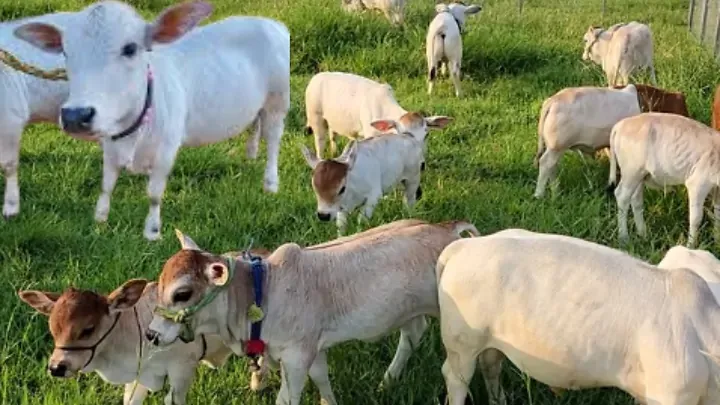
The purchase price is just the entry fee. Here is what the ongoing monthly maintenance cost looks like in 2026:
| Expense | Monthly Cost (INR) |
|---|---|
| Feed (green fodder, dry fodder, mineral supplement) | ₹4,000 – ₹8,000 |
| Veterinary check-up (pro-rated monthly) | ₹500 – ₹1,500 |
| Deworming (quarterly, monthly average) | ₹150 – ₹300 |
| Vaccination (annual, monthly average) | ₹100 – ₹200 |
| Hoof trimming (every 3–4 months, monthly average) | ₹150 – ₹300 |
| Bedding material and shed upkeep | ₹500 – ₹1,000 |
| Total Monthly Estimate | ₹5,400 – ₹11,300 |
Compared to large breeds that can cost ₹15,000–₹25,000/month to maintain, the Punganur is genuinely economical. Just do not let the lower cost fool you into skimping — a cheap, uncertified cow with no vaccination records will cost you far more in vet bills.
Vaccination Schedule for Punganur Cows
Regular vaccination is non-negotiable. Here is the standard schedule recommended by veterinary professionals for Punganur cattle in India:
| Vaccine | Disease Covered | Frequency |
|---|---|---|
| FMD Vaccine | Foot and Mouth Disease | Every 6 months |
| HS Vaccine | Haemorrhagic Septicaemia | Annual (before monsoon) |
| BQ Vaccine | Black Quarter | Annual (before monsoon) |
| Theileriosis Vaccine | Tick Fever | As recommended by vet |
| Brucellosis Vaccine | Brucellosis (female calves only) | Once (4–8 months of age) |
| Rabies Vaccine | Rabies | Annual (if in high-risk zone) |
Always maintain a written vaccination record. Any reputed seller should hand over vaccination documents at the time of purchase — if they do not, that is a red flag.
Common Health Issues in Punganur Cows
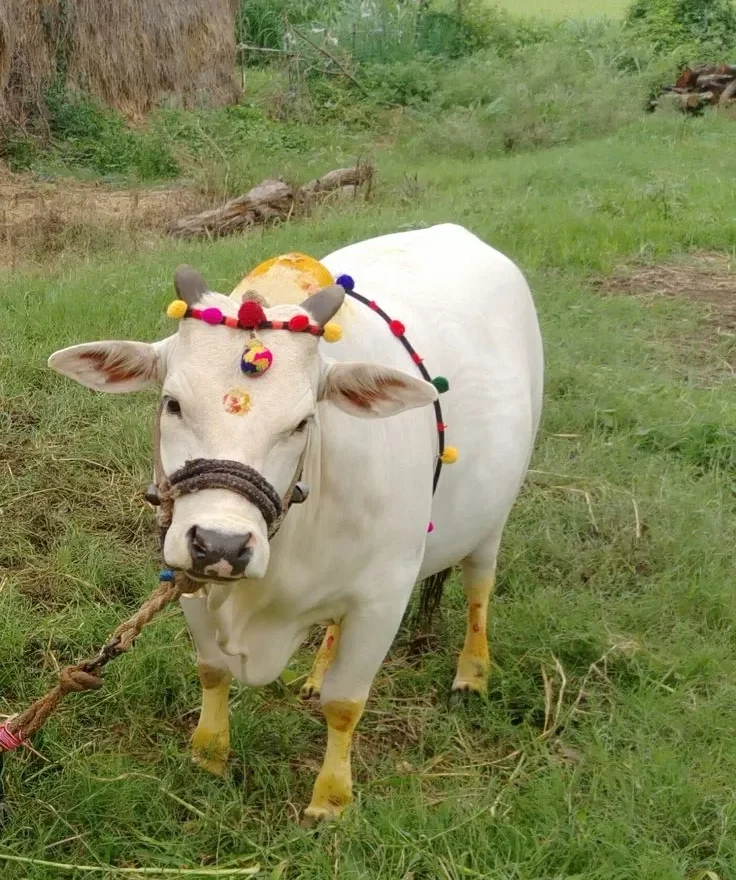
Despite their general hardiness, Punganur cows face several health challenges:
1. Mastitis (Udder Infection) The most common bacterial issue. The udder gets inflamed, milk quality drops. Caused by poor milking hygiene. Prevention: Clean udder before and after milking, check for swelling regularly.
2. Foot and Mouth Disease (FMD) Highly contagious viral disease. Symptoms: Fever, blisters on tongue, lips, and hooves, lameness. Prevention: Biannual FMD vaccination, strict biosecurity.
3. Respiratory Issues / Pneumonia More common in crowded, poorly ventilated spaces. Watch for coughing, nasal discharge, breathing difficulty. Ensure good airflow in the shed at all times.
4. Digestive Problems / Indigestion (Bloat) Often caused by sudden dietary changes or consuming too much green fodder at once. Introduce diet changes gradually.
5. Skin Infections and Tick Infestation Particularly during monsoon season. Regular grooming, parasite control, and clean, dry bedding are the best prevention.
6. Reproductive Issues (Dystocia, Infertility) Calving difficulty and fertility problems can arise from nutritional imbalances, infection, or unethical breeding. Regular vet check-ups and ethical sourcing matter.
How to Identify a Genuine Punganur Breeder
This is where most buyers go wrong. Here is what separates a genuine Punganur breeder from a scammer selling you a mixed-breed small cow:
Green Flags:
- Provides full vaccination records dating back at least one year
- Can show the cow’s lactation history (milk yield log)
- Has a visible, well-maintained farm or gaushala
- Is registered with a state livestock board or Gau Seva Commission
- Welcomes a third-party veterinary inspection before purchase
- DNA certification or breed purity certificate (premium sellers)
Red Flags:
- No vaccination record
- Refuses to allow inspection
- Unusually low price with no explanation
- Cannot explain the animal’s lineage
- Sells only via WhatsApp or social media with no physical location
Online platforms like Pashushala.com do provide verified seller listings, but even there, always inspect the animal physically or send a trusted vet before payment.
Punganur Cow Speed, Bite Force, and Physical Specs
| Physical Parameter | Details |
|---|---|
| Height | 70–97 cm (cows), up to 107 cm (bulls) |
| Weight | 115–200 kg (cows), 200–250 kg (bulls) |
| Lifespan | 12–15 years |
| Speed | ~15–20 km/h (light jog) — not a performance metric for this breed |
| Bite Force | Approx. 150–200 PSI (standard for small cattle; no breed-specific data available) |
| Daily Feed Intake | ~5 kg |
| Daily Water Requirement | 20–30 litres |
Why Is the Punganur Cow So Expensive? Key Price Factors
The Punganur cow price is not just about the animal — it is about everything the animal represents:
- Rarity: The breed’s population was estimated at 9,876–13,275 in 2022. Demand is rising; supply is not growing fast enough.
- Breed Purity: DNA-verified animals cost significantly more. Crossbreds look similar but yield less high-quality milk.
- A2 Milk Premium: All pure indigenous Indian breeds produce A2 milk, and Punganur milk with 8% fat commands a serious premium in today’s health-conscious market.
- Cultural and Religious Value: Temples pay well for Punganur milk. This drives up the floor price.
- Mission Punganur: The Andhra Pradesh government’s 2020 conservation programme (₹69.36 crore allocation, IVF-based breeding) has increased awareness but has not yet flooded the market with animals.
- PM Modi Effect: The Makar Sankranti 2024 photos created a demand spike that has sustained through 2026.
Conclusion
Here is the honest answer: the Punganur cow price is high, but the value is real.
You are paying for rare genetics, culturally significant A2 milk with 8% fat, a gentle temperament, low feed costs, and a 12–15 year partnership with one of India’s most heritage-rich cattle breeds. If you have space for one cow, this is probably India’s most practical desi breed for a small-scale urban or semi-urban setup.
The miniature Punganur cow price in India may feel steep upfront, but monthly maintenance (₹5,400–₹11,300) is genuinely lower than larger cattle. The Punganur cow milk price per litre at ₹80–150 means even modest yields of 3–4 litres/day generate real value.
Just buy smart: verify the breeder, insist on vaccination records, get a vet inspection, and do not fall for rock-bottom prices with no documentation. A cheap Punganur cow with no history is not a deal — it is a gamble.
Key Takeaways:
- Punganur cow price range: ₹50,000 – ₹10,00,000 (realistic adult cow: ₹1,00,000–₹3,00,000)
- Baby Punganur cow price: ₹25,000 – ₹80,000
- Punganur cow milk per day: 3–5 litres
- Punganur cow milk price per litre: ₹80 – ₹150
- Punganur cow height: 70–97 cm
- Monthly maintenance: ₹5,400 – ₹11,300
- Lifespan: 12–15 years
? FAQs About Punganur Cow
Q1. What is the current Punganur cow price in India in 2026?
The Punganur cow price typically ranges from ₹1,00,000 to ₹3,00,000 for a healthy adult cow, with pedigree animals going up to ₹10,00,000.
Q2. What is the Punganur cow price in UP?
In Uttar Pradesh, the Punganur cow price in UP ranges from ₹40,000 to ₹2,00,000. Lower-end listings (₹40,000) on platforms like Pashushala reflect young or lower-yield animals.
Q3. How much milk does a Punganur cow give per day?
Punganur cow milk per day averages 3–5 litres. Peak-lactation, well-fed cows can touch 5 litres; younger or lower-quality animals may give 2 litres.
Q4. What is the Punganur cow milk price per litre?
The Punganur cow milk price per litre ranges from ₹80 to ₹150 in 2026, depending on location and buyer.
Q5. How tall is a Punganur cow?
Punganur cow height is typically 70–90 cm for most cows observed in the field, with scientific measurements (DAD-IS) putting the average at 97 cm for cows and 107 cm for bulls.
Q6. What is the Punganur cow price in Maharashtra and Pune?
The Punganur cow price in Maharashtra ranges from ₹80,000 to ₹3,00,000. Specifically, the Punganur cow price in Pune tends to be slightly higher at ₹90,000 to ₹3,50,000 due to urban demand.
Q7. What is the monthly cost of maintaining a Punganur cow?
Expect to spend ₹5,400 to ₹11,300 per month on feed, vet care, deworming, and housing upkeep.
Q8. Is the Punganur cow a good pet?
Yes. Its gentle temperament, small size, and low maintenance make the Punganur cow one of the best choices for families wanting to keep desi cattle at home, even in semi-urban areas.
Thank You For Reading!
For More Helpful Pet Care Articles, Check Out Our Previous Blogs:
